Classical Paternic, or the native name Petren, was the language of Cyrikon, spoken by the Men of the Patrin Empire after the Binding.
History
Classical Paternic is a classical language belonging to the Cyrikorim branch of the Gemno-Paternic language family. It was originally a tongue spoken in Lower Khez around present-day Cyrikon, but through the conquests of Palagon Patermāgor, Bernīke Bēlkar, and their descendants it became the dominant language in much of Patrinor and Rhusagos. Being the official language of the Patrin Empire, Classical Paternic served as a lingua franca for many centuries, even following the War of the Patrons and the sundering of the Empire. The language was once spoken by approximately 20-30 million people but is no longer the native tongue of any, although it is still used as a liturgical language by the cults of the Kembar and as a literary language by the philosophical community—and most governments of the Wide World.
The written script of the Patrin languages is a logography called the Gindas, although the Preth (an alphabet) also sees some limited use.
Below: The Gemno-Paternic language family tree
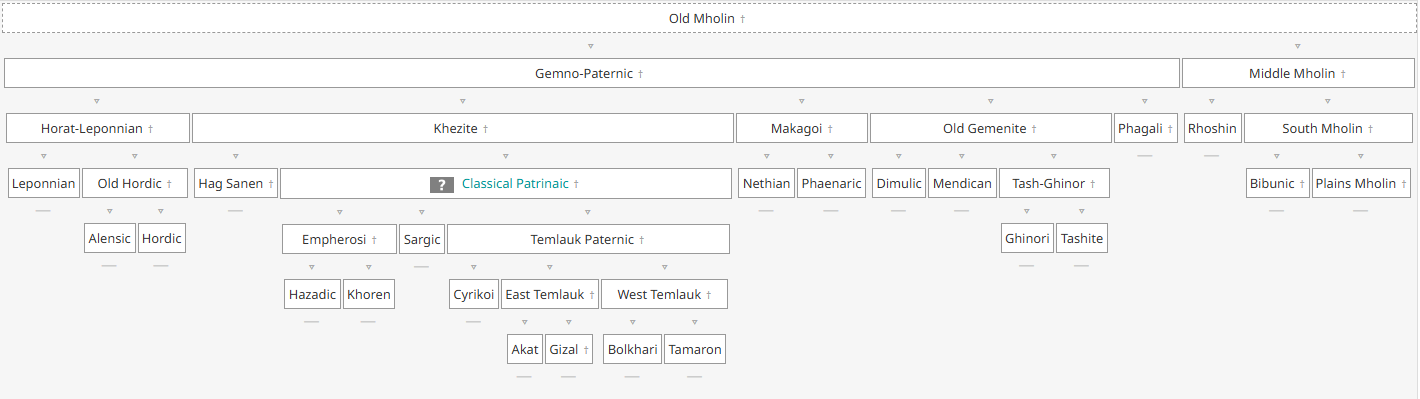
An Overview of the Language
This portion of this article provides a summarized overview of Classical Paternic grammar, focusing on the typologically distinct features of the language. In most instances, technical terminology has been used in order to make the descriptions more precise, although the more obscure terms (and many of the common ones) have hyperlinks to explanatory Wikipedia articles.
Example sentences demonstrating the language will appear in the following three-line format:
(1.1) Abgor                  kurūk           pūkūlae       māres.
      1SG:POSS=master:NOM:SG senate-GEN:INAN bill-ACC:INAN read-PRF
      "My master has read the senate's proposal."
The first line of the example provides the Paternic phrase or sentence, while the second line gives a series of word-by-word glosses (brief explanations or translations). If a word is morphologically complex to any degree, each morpheme is glossed separately (grammatical morphemes are labeled with abbreviations written in caps, morpheme breaks are indicated through a hyphen, a colon is used to express two or more units of meaning expressed by a single morpheme, an equals sign is used to mark clitic boundaries, and grammatical properties signaled by a morphophonological change are marked by a forward slash). The third line gives an English translation set off by single quotes of the given phrase or sentence. Paternic words have not been broken up into their individual morphemes for the sake of readability. An asterisk preceding a Paternic word, phrase, or sentence (for example, *nar derūgud “I am crying”) indicates an ungrammatical form or structure. Where the notation X > Y is used when discussing morphology, X represents the word’s underlying form (with morphemes separated by periods), and Y represents the pronounced form of the word following any phonological transformations. For example, le.elhiz > lēlhiz “hunts by means of” depicts the change where, when the circumstantial applicative prefix le- attaches to a verb beginning with a vowel, the prefix’s vowel becomes deleted through a process of vowel hiatus resolution.
Phonology
The phoneme inventory of Classical Paternic consists of thirty phonemic sounds, twenty consonants and ten vowels, with a length distinction in said vowels. Syllables are maximally CVCC although there are strict limits on permissible CC clusters. Major phonological processes include vowel hiatus resolution, nasal and plosive assimilation, degemination, and epenthesis to resolve illegal consonant and vowel clusters.
| BILABIAL | ALVEOLAR | POST-ALVEOLAR | VELAR | ||
|---|---|---|---|---|---|
| NASAL | m | n | |||
| PLOSIVE | Voiceless | p | t | k | |
| Voiced | b | d | g | ||
| Aspirated* | pʰ (ɸ) | tʰ (θ) | kʰ (x) | ||
| FRICATIVE | Voiceless | s | ʃ | x | |
| Voiced | z | ʒ | ɣ | ||
| APPROXIMANT | l | j | |||
| RHOTIC | ɾ~r | ||||
*Aspirated plosives lenite into voiceless fricatives word finally and when preceding another consonant.
| FRONT | NON-FRONT | ||
|---|---|---|---|
| UNROUND | ROUND | ||
| CLOSE | i iː | u uː | |
| e eː | o oː | ||
| OPEN | ɑ ɑː | ||
Word Classes
Classical Paternic’s major word classes are noun, adjective, verb, and adverb. Nouns and adjectives can inflect as verbs when used predicatively, although the degree of verbal inflection is restricted when compared to proper verbs. Verbs possess two stems with one or the other being inflected depending on the desired meaning. Adverbs are, in the majority of cases, very easily distinguished from the other three categories, which themselves look very much alike.
Nouns possess animacy as an inherent property. Animate nouns are marked for singular and plural number while inanimate nouns are not marked for number. Adjectives, demonstratives, and quantifiers, which typically precede the noun, agree with the noun in case, animacy, and number. Animacy is also reflected in the choice of third person pronouns.
The pronouns in Classical Paternic distinguish three persons and two numbers, with an inclusive/exclusive distinction in the first person plural (phāru “we” [includes addressee] versus pher “we” [excludes addressee]), and an additional reflexive pronoun in the third person (gi “himself/herself”). Oblique, nominative, and ergative pronouns each have a single form, while accusative pronouns have both clitic and full forms and possessive pronouns have only clitic forms. The accusative full forms are used mostly for emphasis or in situations involving quirky subject.
Closed classes include postpositions, conjunctions, quantifiers, preverbal particles which indicate emphasis and alethic modality, and postverbal particles which express clause-type and (rarely) emphasis.
Inflectional Morphology
Classical Paternic is highly fusional and largely suffixing, though prefixes do occur. Apophony is regularly used in nouns to mark the accusative case (for example, balakh “ship” > balekh “ship” [primary object]) and verbs have two different stems each, one for perfective and one for imperfective aspect (for example, naput “burned” versus nembut “was burning”). Compounding and noun incorporation are common derivational strategies.
Nouns are inflected for case, number, and animacy, with a single suffix expressing all of these categories at once. There are eight cases in Classical Paternic: nominative (NOM), accusative (ACC), ergative (ERG), genitive (GEN), allative (ALL), locative (LOC), instrumental (INS), and comitative (COM). The usages of each case can largely be intuited from their traditional usages, although there are a few exceptions. For instance, the ergative case denotes participants in a state of motion away as well as agents of transitive verbs in certain tenses. The allative case is a vestigial case used only for motion towards a small subset of regions, nations, cities, major rivers, islands, and a few other seemingly random words. With the allative having fallen out of use, the genitive case is generally employed to denote motion towards. This idiosyncrasy is demonstrated in the following sentences:
(1.2)  Nar     Rhurnārokh      memāt.
       1SG:NOM Redwater-ALL:AN go:PRS
       "I am going to the Redwater."

(1.3)  Nar     khōrok       nūs    memāt.
       1SG:NOM river-GEN:SG toward go:PRS
       "I am going to the river."

(1.4)  Nar     khōrā        memāt.
       1SG:NOM river-ERG:SG go:PRS
       "I am going away from the river."
In addition to semantic roles, case marking can be affected by the tense of the verb. For example, the nominative and accusative cases are typically used to mark the agent and patient. However, when a transitive verb is placed in the imperfect or preterite tenses, as will be shown below, the ergative and nominative cases are used to mark the agent and the patient respectively. The nominative case is still used to mark the agent of intransitive verbs in the imperfect and preterite tenses.
(1.5)  Zōres       ghāzae        nemeb.
       fire-NOM:PL tree-ACC:INAN burn:PRS
       "The fire is burning the tree(s)."

(1.6)  Zōres       nembut.
       fire-NOM:PL burn-IMPF
       "The fire was burning."

(1.7)  Zōrēs       ghāz          nembut.
       fire-ERG:PL tree:NOM:INAN burn-IMPF
       "The fire was burning the tree(s)."
Only animate nouns inflect for number in Classical Paternic. However, while inanimate nouns are not themselves marked for number, adjectives, demonstratives, and quantifiers modifying inanimate nouns do agree in and inflect for number. This is demonstrated in the following examples:
(1.8)  abed             ēstel
       arid:NOM:INAN:SG island-NOM:INAN
       "the arid island"

(1.9)  abdes            ēstel
       arid-NOM:INAN:PL island-NOM:INAN
       "the arid islands"
One typologically rare feature of Classical Paternic is that it is a secundative language, treating the core arguments of ditransitive verbs differently than most nominative-accusative languages. Instead of treating the patient of a transitive verb and the theme of a ditransitive verb the same and giving the recipient special marking as indirective languages do, Classical Paternic consistently marks the transitive verb’s theme and the ditransitive verb’s recipient (both of which will henceforth be referred to as the primary object or PO) as the same, placing them both in the accusative case. The theme (hereafter called the secondary object or SO) is placed in the instrumental case. Compare:
(1.10)  Akhon        undae         emūs.
        child:NOM:SG rock-ACC:INAN bring:GNO
        "The child brings rocks."

(1.11) Akhon       undōm         gan          emūs.
       child:NOM:SG rock-INS:INAN woman:ACC:SG bring:GNO
       "The child brings the woman rocks."
       lit. "The child brings to the woman by means of rocks."
As can be seen in (1.10), these secundative constructions are essentially analogous to some structures found in English wherein the recipient is marked as the direct object by means of dative shift, a process which also renders the theme as an oblique argument.
Verbal inflection in Classical Paternic is fairly robust, with verbs taking many suffixes and a small number of prefixes across two separate stems to mark tense, aspect, mood, some valency-changing operations, and non-finite forms. The following examples, featuring the verb nemeb, nap “burn”, give a sense as to this morphology:
- nemeb “is burning, will be burning” list-grid
- nap “burns, will burn”
- nembut “was burning”
- naput “burned”
- napus “has burned”
- napuret “has been burned”
- napun “had burned”
- napunet “had been burned”
- nembukūs “used to burn”
- napo “burned (long ago)”
- nembe “would burn”
- nape “would have burned”
- napubek “should burn, burn”
- napukh “may burn, can burn”
- napa “must burn”
- napumi “will burn”
- īnap “burns for”
- thonap “burns to the detriment of”
- āgnap “burns at”
- lenap “burns by means of”
- napezh “while burning”
- napakh “in order to burn”
- napil “burning, to burn”
- napos “that burned”
- nembos “that is burning”
- napuned “that was burned”
An extensive system of converbial suffixes is also employed by Classical Paternic for most instances of verb subordination, as depicted by the examples provided below:
(1.12) Tar     phelae         sebdith   ghado.
       2SG:NOM water-ACC:INAN pour-ICVB drink-PRET
       "You poured the water and also drank (it)."

(1.13) Tar     phelae         sebdad    ghado.
       2SG:NOM water-ACC:INAN pour-PCVB drink-PRET
       "You poured the water and then drank (it)."

(1.14) Tar     phelae         sebdadlae     ghado.
       2SG:NOM water-ACC:INAN pour-INCH:CVB drink-PRET
       "You poured the water just before you drank (it)."

(1.15) Tar     phelae         sebdethe     ghado.
       2SG:NOM water-ACC:INAN pour-ANT:CVB drink-PRET
       "After pouring the water, you drank (it)."
In addition to the above inflectional categories, verbs also take pronominal proclitics which express a verb’s primary object (for example, nar enūstel “I am removing” versus nar bālenūstel “I am removing him”).
Furthermore, predicative adjectives and nouns can take some verbal morphology to convey meanings other than the default gnomic indicative interpretation. Observe:
(1.16) Dūm      akhon.
       3ASG:NOM child:NOM:SG
       "He/she is a child"

(1.17) Dūm      akhono.
       3ASG:NOM child-PRET
       "He/she was a child."

(1.18) Dūm      akhona.
       3ASG:NOM child-GNO:NEC
       "He/she needs to be a child."
A copula is required for the inflection of non-finite forms, however. This is evidenced by the fact that (1.19) is ungrammatical, as opposed to the perfectly acceptable (1.20)
(1.19) *Dūm      tāsil   āth.
       3ASG:NOM man-MSD about_to_be-PRS
       *"He is about to be a man."

(1.20) Dūm      tās        eril      āth.
       3ASG:NOM man:NOM:SG be_at-MSD about_to_be-PRS
       "He is about to be a man."
Constituent Orders and Clause Structure
Classical Paternic is predominantly head-final in its noun phrases. Possessors and adjectives usually precede their head noun, as can be seen by comparing the phrase khar “house” with the phrases ūkok khar “the person’s house” and ūkok rhus khar “the person’s red house”. Demonstratives and quantifiers also typically precede the noun they modify, as well as relative clauses. This is shown in (1.21) below. Observe also that a resumptive pronoun is used when the antecedent is the primary object. Gapping is used only when the antecedent is the subject.
(1.21) Gan          bāltenembut       men  postān          nar     pero.
       woman:NOM:SG 3ASG:SG=calm-IMPF COMP animal:NOM:INAN 1SG:NOM see-PRET
       "The animal that the woman is calming saw me."
It should be noted, however, that all of the constituent orders described above are not absolute, and can be modified with little issue. On occasion, for emphasis or poetic license, possessors and adjectives follow the modified noun. This is a technique also regularly employed in place names. In addition, placing a demonstrative or quantifier after its head noun can be used as a form of emphasizing salience or definiteness. Additionally, as a strictly postpositional language, Classical Paternic adpositions almost universally follow their complement.
At the clausal level, constituent order is fairly free, though there is a clear preference for verb-final (SOV) order. Typically, clauses are made of a verb preceded by one or more case-marked pronouns or noun phrases. The ordering of these noun phrases is determined primarily by the discourse prominence of each constituent, which is demonstrated by the sentences below. In this way, Classical Paternic operates as a scrambling language akin to Latin or Japanese.
(1.22) Īs      bashae         ghodbephek.
       2PL:NOM tower-ACC:INAN rebuild-PRS
       "Y'all are rebuilding the tower."

(1.23) Bashae         īs      ghodbephek.
       tower-ACC:INAN 2PL:NOM rebuild-PRS
       "Y'all are rebuilding the tower."
       or "The tower is being rebuilt by y'all."
In sentences with more than one noun phrase, the most topical noun phrase (a noun phrase identifying the individual the sentence is talking about) typically occurs at the beginning of the clause. Often, the topic is interpreted as definite or salient. For instance, in the sentences above, (1.22) might be used to attribute an action to those rebuilding while (1.23) might be used to describe something happening to the tower. Please note that while a passive translation of (1.23) has been provided, there is no passive structure present. The passive voice was used in order to illustrate that the primary object was more topical than the subject.
Furthermore, the most rhematic noun phrase (a noun phrase providing foregrounded information commonly referred to as the rheme) will usually immediately follow the topic. Observe the sentences below, which differ only in the ordering of the accusatively-marked primary object and locatively-marked location. (1.24) has a more rhematic primary object, meaning the sentence is depicting the antelope as new information and the valley’s presence has been presupposed. In (1.25), by contrast, the antelope has been backgrounded and the valley is considered a more salient detail. The first sentence might be used to answer the question “What did the person see in the valley?” while (1.25) might be a response to “Where did the person see the antelope?” In the event that both the antelope and valley are equally foregrounded or equally backgrounded, the primary object will normally be placed in the rhematic position.
(1.24) Ūk            lamonis         lazha         per.
       person:NOM:SG antelope-ACC:PL valley-LOC:SG see:GNO
       "The person sees THE ANTELOPE in the valley."

(1.25) Ūk            lazha         lamonis         per.
       person:NOM:SG valley-LOC:SG antelope-ACC:PL see:GNO
       "The person sees the antelope IN THE VALLEY."
Although Classical Paternic is largely head-final with a default SOV order, there are a number of embedded clause types which act head-initially rather than head-finally as one would expect. A general rule of thumb is that embedded clauses with finite verb forms, other than relative clauses, are head-initial while embedded clauses with non-finite verb forms are head-final. Typically, verbs of knowledge, propositional attitude, and utterance take finite complements and verbs of perception, desideratives, and phasals take non-finite complements. A series of example sentences demonstrating these two types of embedded clauses has been provided below.
(1.26) Nar     lōko     shās dūm      ghado.
       1SG:NOM say-PRET QUOT 3ASG:NOM drink-PRET
       "I said "he/she drank."

(1.27) Nar     keno      shās  dūm      ghado.
       1SG:NOM think-PRET QUOT 3ASG:NOM drink-PRET
       "I thought that he/she drank."

(1.28) Nar     duko      shās dūm      ghado.
       1SG:NOM know-PRET QUOT 3ASG:NOM drink-PRET
       "I knew that he/she drank."

(1.29) Dūm      ghado      men  nar     lōko.
       3ASG:NOM drink-PRET COMP 1SG:NOM say-PRET
       "I said that he/she drank."

(1.30) Nār     bālgadil            pero.
       1SG:NOM 3ASG:POSS=drink-MSD see-PRET
       "I saw that he/she drank."
       lit. "I saw his/her drinking."

(1.31) Nar     ghadil    men  pāgo.
       1SG:NOM drink-MSD COMP want-PRET
       "I wanted to drink."

(1.32) Nar     ghadil    men  būzet.
       1SG:NOM drink-MSD COMP stop-PRET
       "I stopped drinking."
Recognize that different complementizers are used depending on if the embedded clause is finite or non-finite. In (1.26), (1.27), and (1.28) above, sentences with a finite embedded clause, the complementizer shās, called the quotative, is used. Although (1.29) also has a finite embedded clause, it uses the non-finite complementizer men. Men is only used in this way to indicate indirect speech, and in such cases it has the same distribution as shās. Furthermore, (1.30) lacks the non-finite complementizer men, which the other non-finite embedded clauses presented above make use of. This is because the specific construction used in (1.30), wherein a possessive clitic marks the subject of the masdar (a verb form with properties similar to both infinitives and gerunds), requires the deletion of the non-finite complementizer. The constructions in (1.31) and (1.32) do not require the use of men, but it has been included regardless to demonstrate its head-final syntax. The complementizer men is also used in relative clauses as a relativizer.
Other Names
The most common Paternic word for Classical Paternic is Petren. Other common names for the language in Classical Paternic are Peternekh Hag (“the Patrin language”), Ebhag (“our language”), and Zhē Hag (“the language”).
Inspiration
Classical Paternic draws inspiration phonologically and grammatically from Latin, Akkadian, Greenlandic, Hindustani, Nahuatl, Bengali, Hebrew, Lezgian, the Salishan languages, Tolkien’s Sindarin and Adûnaic, Biblaridion’s Nekachti, and many others, although it does not greatly resemble any of these tongues outside of the occasional lexical similarity.