Nīmlad
General InformationPronunciationP: [ˈniːm.läd] (NEEM-lahd)
Other NamesWide World, Great Work, Kingdom of Earth
LocationMeleth
TypeWorld
DescriptionHabitable moon orbiting a gas giant
RegionsTethros (Rhusagos, Patrinor, Home Islands), Far North, Far South, Moonless Lands
People and HistoryInhabitantsKembar, Elder Children, Younger Children
“Hence they came to a globed world, which is now named Nīmlad, the Sky and Sea; and they entered into it, and their power was poured into the World, and became bound to it, and flowered and withered it.”
Nīmlad, also known as the Wide World and the Earth, is the world as a whole. It was originally a barren moon within Meleth until it was discovered and shaped by the Kembar.
Nīmlad is the home of Men, Elves, Dwarves, Trogmunders, and other races.
Description
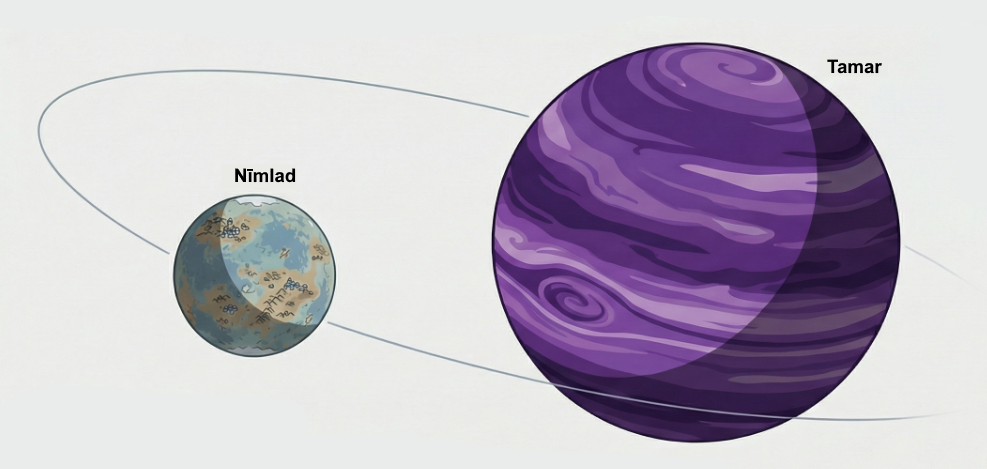
Nīmlad is a moon orbiting about the purple-blue gas giant called Tamar, to which it is tidally locked. Thusly, from any location on Nīmlad’s surface, Tamar appears forever fixed at one point in the sky. A day on Nīmlad is equivalent in time to the moon’s orbital period around Tamar.
From the correct latitudes (such as those between the bounds of Rhusagos and Patrinor), Tamar eclipses the sun for about an hour sometime in the afternoon. This period is known as the dark hour. Also, time can be told based on how much of Tamar is in shadow at any particular moment.
The Children define their year as the time elapsed between Yuledays (a 365-day period). Each Yuleday, extreme aurora displays light up every sky on Nīmlad. This phenomenon is caused by the moon slipping into the boundary of Tamar’s magnetosphere at the conclusion of its apsidal period (which takes a year to complete), leading to Nīmlad’s atmosphere experiencing more solar wind than usual for about a day every year.
At this point in time, the Wide World’s degree of technological advancement is roughly equivalent to that of our late Iron Age. Chariots have only recently been phased out of militaries in favor of cavalry, and dromons and catamarans are the largest watercraft on the sea. However, bronze on Nīmlad is still far more commonly used than iron. This is due to the fact that tin and copper (the combination of which creates bronze alloys) are far more abundant on this world’s surface than they are on Earth, while iron is relatively rare. Steel, therefore, is an extremely valuable metal, and few know how to make it.
Etymology
Nīmlad means “Sky and Sea”, being derived from Classical Paternic nīmil (“sky”). It is an artifact of when the dual number existed in the languages. More specifically, it comes from a specific usage of the dual known as the elliptical dual, wherein two entities associated with each other could be referred to using the dual form of one of that pair. In this instance, the pairing was the sky and the sea.