The Sargāzat
General InformationOther NamesPheropic Sea
LocationSouth of Fost, off the White Sea
TypeSound
DescriptionLarge arrowhead-shaped sound
RegionsSepora, Ithi Bay, Rebshenor, Sargiban, Lalo’s Bay, Hermestel, Dorikhos
Major CitiesSepos, Līm Haub, Zor Barāndo, Iimak-nūs-Ion, Herītor, Ishin
People and HistoryInhabitantsPatrin, Westermen, Ithrim, Dwarves, Ghodgebosh (Wood Trogs, Deep Trogs), Meadow-Elves (mostly gone)
GovernancePheropic Empire
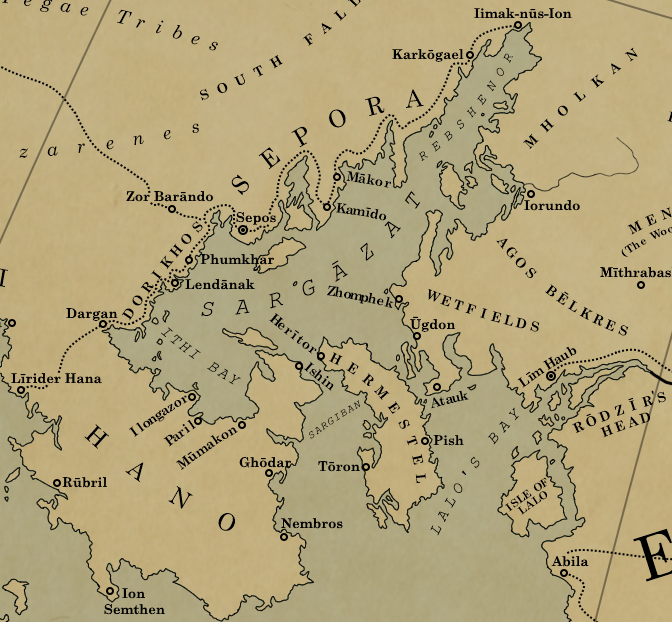
The Sargāzat is an ocean-arm in the rough shape of an arrowhead that pierces far into the land, dividing the realms Relkor and Empheros. It is a sea unto itself, bearing many vessels and ferried goods from shore to shore.
Description
The Sargāzat is very large, being 85 leagues from end to end. Its denizens, therefore, have taken to subdividing the waters of the Sargāzat into smaller portions. The most common of these divisions are the following:
- The Sargāzat, being the main body of the sound. Sepora, the Dwarven land of Dorikhos, and the Wetfields are beside its shores.
- Ithi Bay, being a southwestern corner of the sound that borders the peninsula Hano.
- Rebshenor, being the northernmost part of the Sargāzat. It was once the home of the Meadow-Elves.
- Sargiban, being one of the two ingresses into the Sargāzat. Herītor and Ishin lie upon either side of it.
- Lalo’s Bay, being the Sargāzat’s other entrance. Līm Haub, the last great city of the Wood Trogs in Rhusagos, is there.
The isle Hermestel sits in the south of the Sargāzat, bisecting its mouth into two ways of entry.
History
The majority of the Trogmunders dwelt at Rōdzīr’s Head beside Lalo’s Bay in the days shortly after the Binding. After Good Lalo completed his quest and returned to his homeland, he called for a conclave. There he bade the Trogmunders follow him into the west so that they might settle a great archipelago that he had found. The greater part of the clans elected to depart with him, though some refused the summons. Afterwards the Trog clans became estranged.
The Patrin began colonizing the Sargāzat in the early 8th century AB. The Gutter Wars were born out of Nen-Hāspis’s desire to conquer Sepora, which at that time was under the dominion of Regimen Māgor. Eventually, the Patrin would win the Gutter Wars and install governors in much of the Sargāzat, although the cities of Ithi Bay remained independent.
In the year 1113 AB, inspired by Umbad’s rebellion, Pherop, a servant of the governor of Sepora, revolted against his master and seized control of the fort Sepos. While the War of the Patrons raged on, he annexed the neighboring provinces, having declared himself Lord of the Sargāzat; and about Sepos, his seat and fastness, a new city sprouted.
For many years, it dominated the region, but Pherop is long dead. Now Sepos’s power is waning, and much of the Sargāzat has wrested itself free of the city’s influence. However, many of those city-states have fallen out of one shadow only to find themselves in another. For Rennick, the newly-crowned King of Westerland, is bent on the great fleets of the Sargāzat and Alensis, which he can only obtain through war.
Etymology
Sargāzat is made up of the components sargās, which is the locative plural inflection of sargi (“seaweed”), and the postposition lat (“beyond, on the other side of”). The Patrin likely referred to the area initially as nahan sargās lat (“the place beyond the weeds”), though it is clear that the phrase’s elements have long since been conjoined due to frequent use.
The sound was so named because the Patrin needed to sail through the weed-choked waters of Sargiban to reach it.